
What It Costs
What This Work Costs
We're not going to print a number for a job we haven't seen. What we will do is tell you what moves the price, and give it to you before the work starts.

We're not going to print a number for a job we haven't seen, and here's the honest reason: the same symptom can be a twenty-minute fix or a full pump replacement. A website number that turns out to be wrong is worse than no number. What we can promise is this — you'll get the price before the work starts, not after.
What actually moves the price
Whether the pump has to come out of the well at all
This is the single biggest fork in the road, which is why diagnosis comes first. A pump that stays in the well is a different day's work from a pump that has to be pulled.
How deep the well is and how far down the water stands
Depth changes the pump, the wire and the pipe. A deeper well needs more of all three, and the pump has to be matched to the lift.
Submersible or jet
Different equipment, different labour. A submersible lives down the well; a jet pump lives in the basement. They're not interchangeable without changing the rest of the system.
Two-wire or three-wire
Three-wire brings a control box into it. Two-wire doesn't. Which you have changes what comes out and what goes back in.
What else is coming out with the pump
Wire, drop pipe, safety rope, check valve, torque arrestor, well cap, pitless adapter. Reusing a corroded fitting or a brittle wire is how a new pump ends up back out of the well in two years.
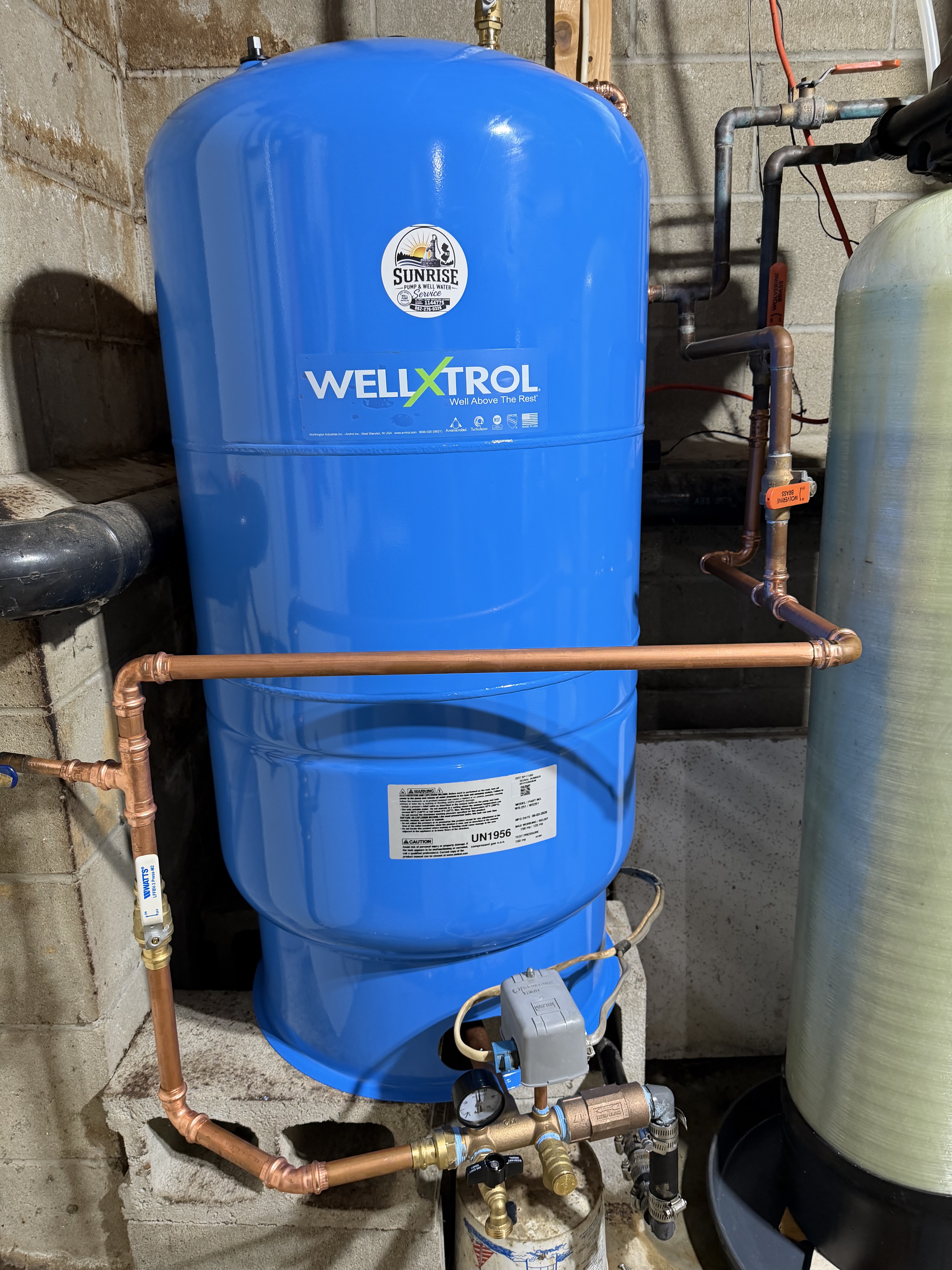
The condition of the tank tee and the pressure tank
On a tank that's been in place for years, the fittings are usually seized, scaled or weeping. Doing the tank and the tee at once is usually cheaper than doing them six months apart.
Access
A wellhead behind a shed, under a deck, in a pit, or a hundred feet up a slope is a different day's work from one standing clear in the yard.
Whether the water is safe to use immediately
If the system was opened, it needs disinfecting and retesting before it goes back into service. That's part of the job, not an extra.
For treatment work: what the test result actually says
Iron and manganese levels, pH, hardness and whether iron bacteria are present all change the equipment. Anyone quoting treatment off a description of a stain is guessing.
Distance
Wantage to Ringwood or Belvidere is a real drive, and we'd rather be honest about that than pretend geography is free. We schedule the far towns in blocks.
Why we diagnose before we quote
A waterlogged tank, a burnt pressure switch, a tripped breaker or a blocked sediment filter can all present exactly like a dead pump, and every one of them is a fraction of the cost. Anyone who quotes a pump replacement over the phone from a description of the symptom is guessing, and the guess is never in your favour. See our no water and pump repair page for the checks that tell you which it is.
The one number we can give you, and it isn't ours
If you're selling or renting a home on a well in New Jersey, the Private Well Testing Act requires a test of the untreated groundwater, and the New Jersey Department of Environmental Protection estimates the average price of that testing at $1,200 to $1,500 — with possible additional cost if a field blank has to be analysed, which is required for PFAS and VOCs. That is a laboratory cost, not ours. See our Private Well Testing Act page.
How to compare two quotes
- •Does the quote say what's being replaced and what's being reused?
- •Does it include the wire and the drop pipe, or only the pump?
- •Does it include disinfecting the well afterwards?
- •Does it include the tank tee, or only the tank?
- •What happens to the price if the diagnosis changes once the system is open?
- •Is the licence number on the paperwork? See our NJ pump installer licence page.
What we won't do
We won't pull a pump to find out whether the pump is the problem. We won't sell treatment equipment off a description of a stain instead of a test result. And we won't quote a number we can't hold.
Diagnostic fees and estimates
There is no diagnostic fee within 25 miles. Past 25 miles a diagnostic fee applies, and we waive it entirely if you hire us for the work — no matter how far out you are. Call and we will tell you exactly what applies to your address before we come out.
Simple jobs within 25 miles are usually quoted at no charge. Complex problems take real diagnostic time, so those estimates may carry a fee — and it is waived if you hire us. We will tell you which yours is on the phone.
Straight answers
Questions we get on this one
Can you give me a ballpark over the phone?
We can tell you what it usually turns out to be, and we can tell you what we'd check first. What we won't do is quote a pump replacement from a description of the symptom, because the same symptom can be a pressure switch. The honest answer is that we diagnose, then quote.
Do you charge to come out?
There is no diagnostic fee within 25 miles. Past 25 miles a diagnostic fee applies, and we waive it entirely if you hire us for the work — no matter how far out you are. Call and we will tell you exactly what applies to your address before we come out.
What if it turns out to be something cheap?
Then you pay for the cheap fix. A waterlogged tank, a burnt pressure switch, a tripped breaker or a blocked filter can all look like a dead pump, and every one of them is a fraction of the cost. We'd rather find the cheap cause and say so than sell you a pump you didn't need.
Do you take cards?
Yes, we accept credit cards. We don't publish other payment terms, deposits or financing arrangements here — we'll cover those when we talk about your job.
Will my homeowner's insurance cover a well pump?
Sometimes, and it depends on the cause. A pump that failed from age or wear is usually on you; damage from a covered peril like a lightning strike may be covered. That's a question for your insurer and your policy, not for us — we'll document what we found either way.
Is it worth replacing a pump, or the whole system?
It depends what the rest of the system is doing. If the pressure tank is at the end of its life too, doing both at once is usually cheaper than doing them six months apart — one visit, one disinfection, one set of fittings. We'll tell you what we'd do and why, and you decide.
We answer around the clock
No water? Call. Don't type.
(862) 276-0328No water right now? Call (862) 276-0328.
Or request service online — but if you're standing in a dark basement with no water, the phone is faster.