
Well Tank · Pressure Tank
Well Tank and Pressure Tank Replacement in Northwest New Jersey
The pressure tank is the part of a well system almost nobody thinks about, and the part that quietly destroys pumps. A failing tank doesn't cost you a tank — it costs you a pump.

What the tank actually does
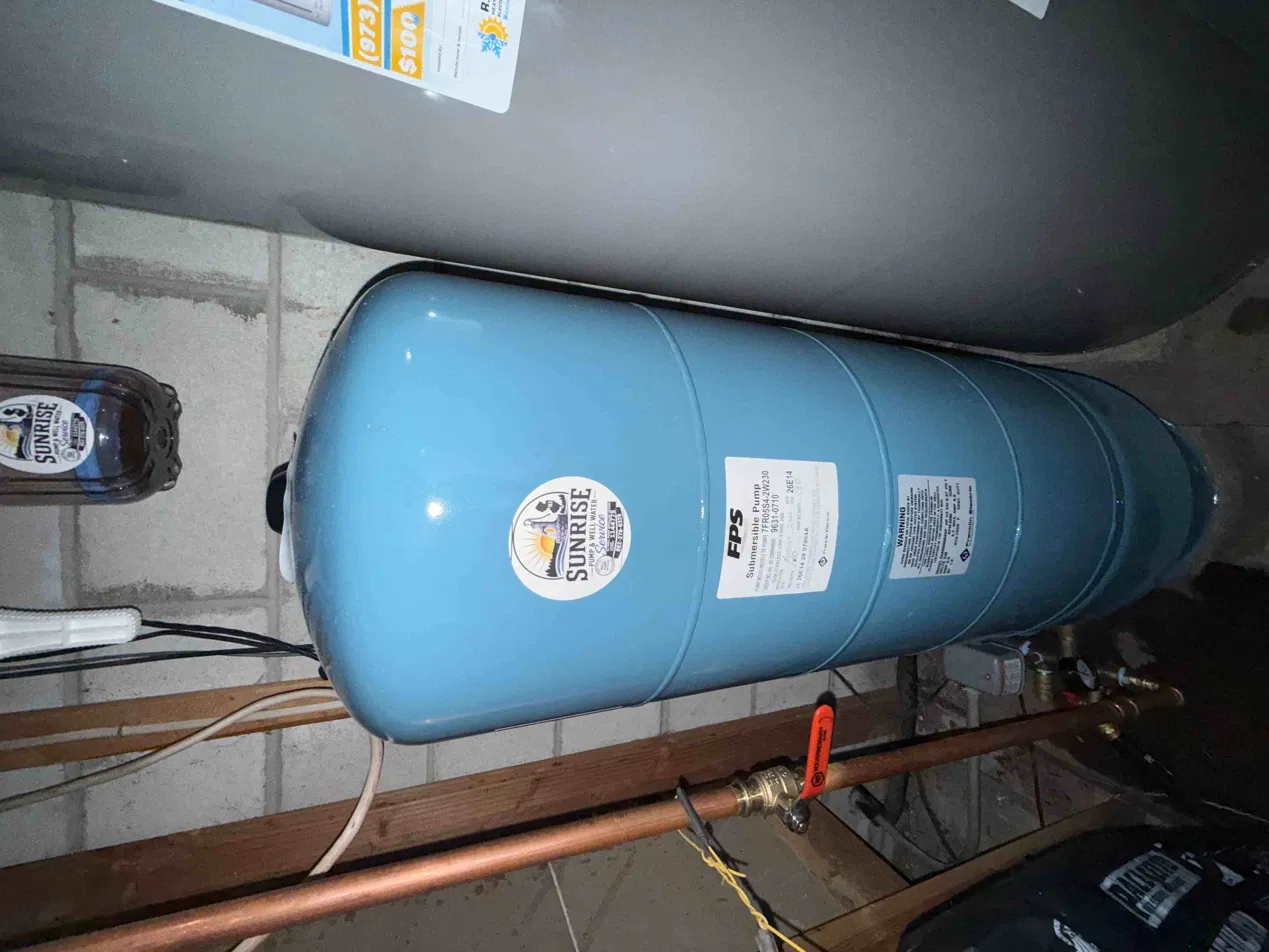
The tank holds a cushion of compressed air against a rubber bladder or diaphragm. That cushion is what gives you water between pump cycles and what keeps the pump from starting every time somebody opens a tap. When the air charge is gone, the tank is just a steel can full of water and the pump takes the whole job — turning on and off every few seconds until it gives up.
How to tell yours is failing
- The pump cycles on and off rapidly while a single tap runs. This is the classic sign, and it's the one that kills pumps.
- Pressure drops off almost immediately when you open a faucet.
- The tank feels heavy or sounds solid all the way to the top when you tap down the side.
- Water spits from the air valve on top of the tank.
- Visible rust at the seams, or at the bottom where it meets the stand.
Here's the important part: rapid cycling is not a nuisance, it is wear. Every start is hard on a pump motor. A tank that's been short-cycling for months can take a pump with it, and that's how a cheap problem becomes an expensive one.
Air charge — the thing that gets set wrong
The tank's air pre-charge has to be set to match the pressure switch's cut-in point. A tank charged to whatever came on the sticker from the factory will short-cycle from the day it goes in if that number doesn't match your switch. We set the air charge to the switch on your system and check it with the tank drained, because that's the only way to read it accurately.
The full T-package
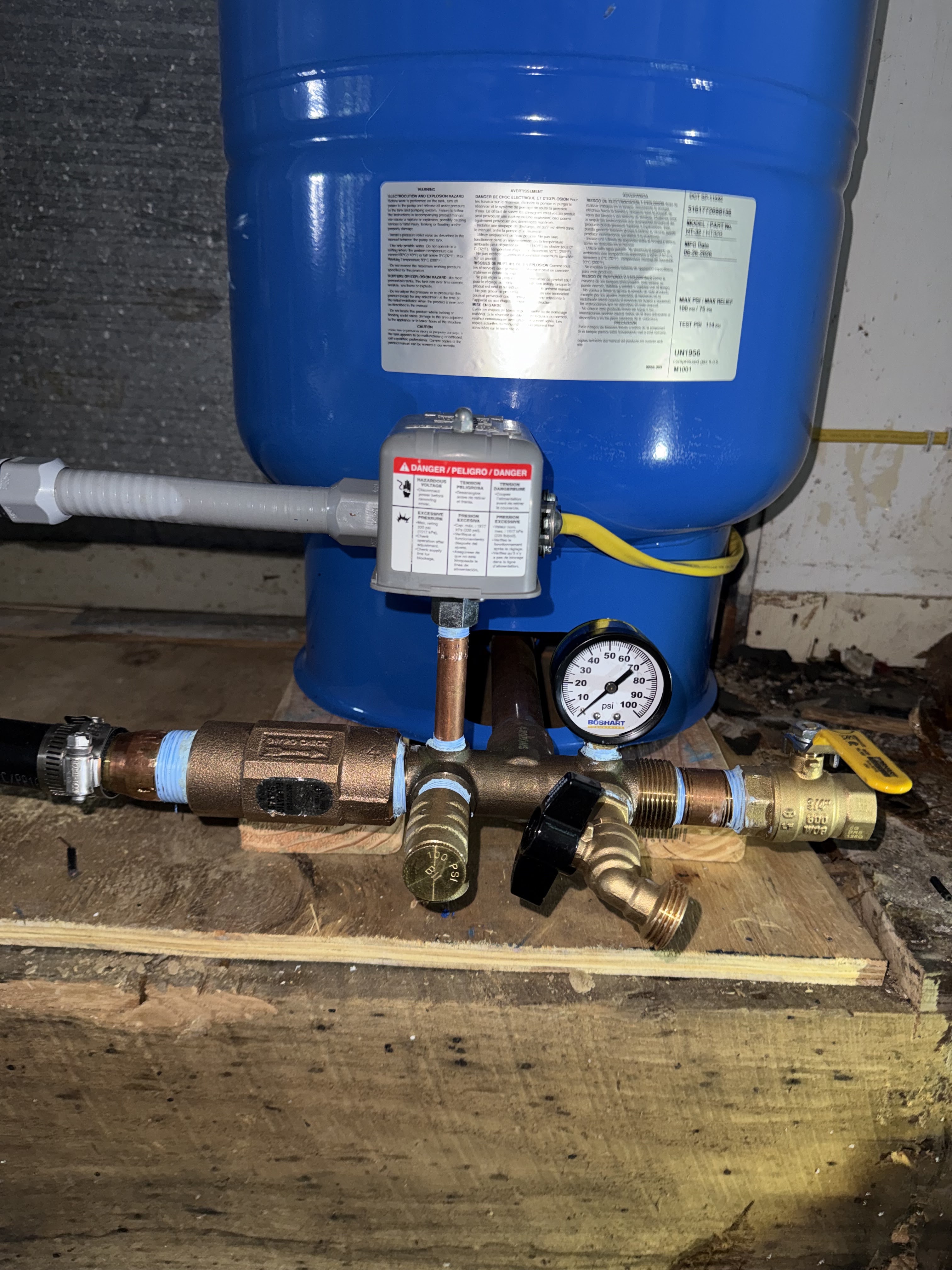
The tank tee is the manifold on the side of the tank that carries the pressure switch, the pressure gauge, the relief valve, a boiler drain and the unions. On a tank that's been in place for years, those fittings are usually seized, scaled or weeping. Changing the tank while leaving twenty-year-old brass on it is how you get called back.
We'd rather quote the whole assembly than the cheapest version of the job. A new tank on old, leaking fittings is a job half done, and we don't like leaving a job half done.
Sizing, honestly
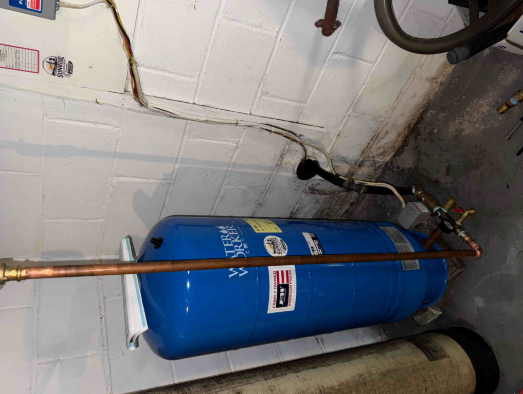
A bigger tank means fewer pump starts and longer pump life. It also means more space and more cost. The right answer depends on the pump, the well's yield, and how much room there is next to the furnace. We size it to your system rather than handing you the same tank we hand everyone.
Galvanized tanks
Older galvanized tanks with no bladder are still out there in this area. They work, they waterlog, and they're a candidate for replacement rather than repair. The bladder design came along because a tank with an air charge that can't escape holds its cushion longer and doesn't waterlog the way a plain steel tank does. We don't disparage the old tanks — we explain why the design changed, and why a bladder tank is usually the better replacement.
Where we work
Sussex County top to bottom, northern and central Warren County, and the northern Passaic County highlands. See the service area map. We don't promise a response time to any town.
Drilling a new well and sealing an old one are a different licence — a licensed well driller — and we don't do that work. See our NJ pump installer licence page. Related: our well pump replacement page and our low water pressure page.
Straight answers
Questions we get on this one
How long does a pressure tank last?
It depends on how much it's cycled, the water chemistry, and whether the air charge was ever set right. A tank that short-cycled its whole life won't reach the same age as one that didn't. We won't give you a number because the honest answer is that it varies, and we'd rather say so than print a figure that's wrong for your tank.
Can you just recharge the air instead of replacing it?
Sometimes, if the bladder is intact and the air just leaked out over time. But if the bladder has ruptured, the tank is full of water and recharging it won't hold — the air dissolves straight back into the water. We check whether the bladder is still good before we tell you to replace anything.
Why is my new tank cycling?
Either the air pre-charge wasn't set to match your pressure switch, or the tank is too small for the pump's flow. A tank charged to whatever was on the sticker from the factory will short-cycle from the day it goes in if that number doesn't match your switch. We set it to the switch on your system.
Does a bigger tank increase my water pressure?
No. A bigger tank holds more water between pump cycles, which means fewer starts and longer pump life — but it doesn't change the pressure the switch is set to. Pressure comes from the switch and the pump, not the tank.
Can the tank make my water taste metallic?
An older galvanized tank with no bladder can leach a metallic taste as it corrodes inside. A modern bladder tank shouldn't. If the taste started when the tank was already old, the tank is a suspect.
Do I have to shut the well off to change it?
Yes — we shut the pump off and drain the system down to the tank to change it safely. You'll be without water for the length of the job, which is one of the reasons we get in and get it done rather than dragging it out.
We answer around the clock
No water? Call. Don't type.
(862) 276-0328No water right now? Call (862) 276-0328.
Or request service online — but if you're standing in a dark basement with no water, the phone is faster.