
Iron, Manganese & Sediment Filtration
Iron, Manganese and Sediment in Well Water
These three get lumped together because they all show up as something visible, and they have three different causes and three different fixes.

Telling them apart by what you can see
- •Iron — orange or reddish-brown staining in sinks, tubs and laundry; water that's clear from the tap and turns colour after standing.
- •Manganese — black or dark brown specks and staining, often worse in the toilet tank and the dishwasher.
- •Iron bacteria — a reddish-brown slime or sheen, a swampy or oily smell, and clogging in filters, pressure switches and toilet tanks. This is a living nuisance organism, not a health contaminant, and it needs a different approach to plain iron.
- •Sediment — grit and sand in aerators and filter housings.
The standards, correctly framed: iron at 0.3 mg/L and manganese at 0.05 mg/L are NJDEP recommended upper limits for secondary contaminants. These are aesthetic limits about staining, taste and colour — not health violations.
Where sediment comes from, and why it's a warning
Real sand or grit usually means something about the well, not the plumbing — a deteriorating well screen, a pump set too close to the bottom, or a well being pumped hard enough to draw fines in. A sediment filter treats the symptom, and the cause is worth diagnosing, because grit going through a pump is wear on the pump. See our no water and pump repair page.
What actually removes iron and manganese
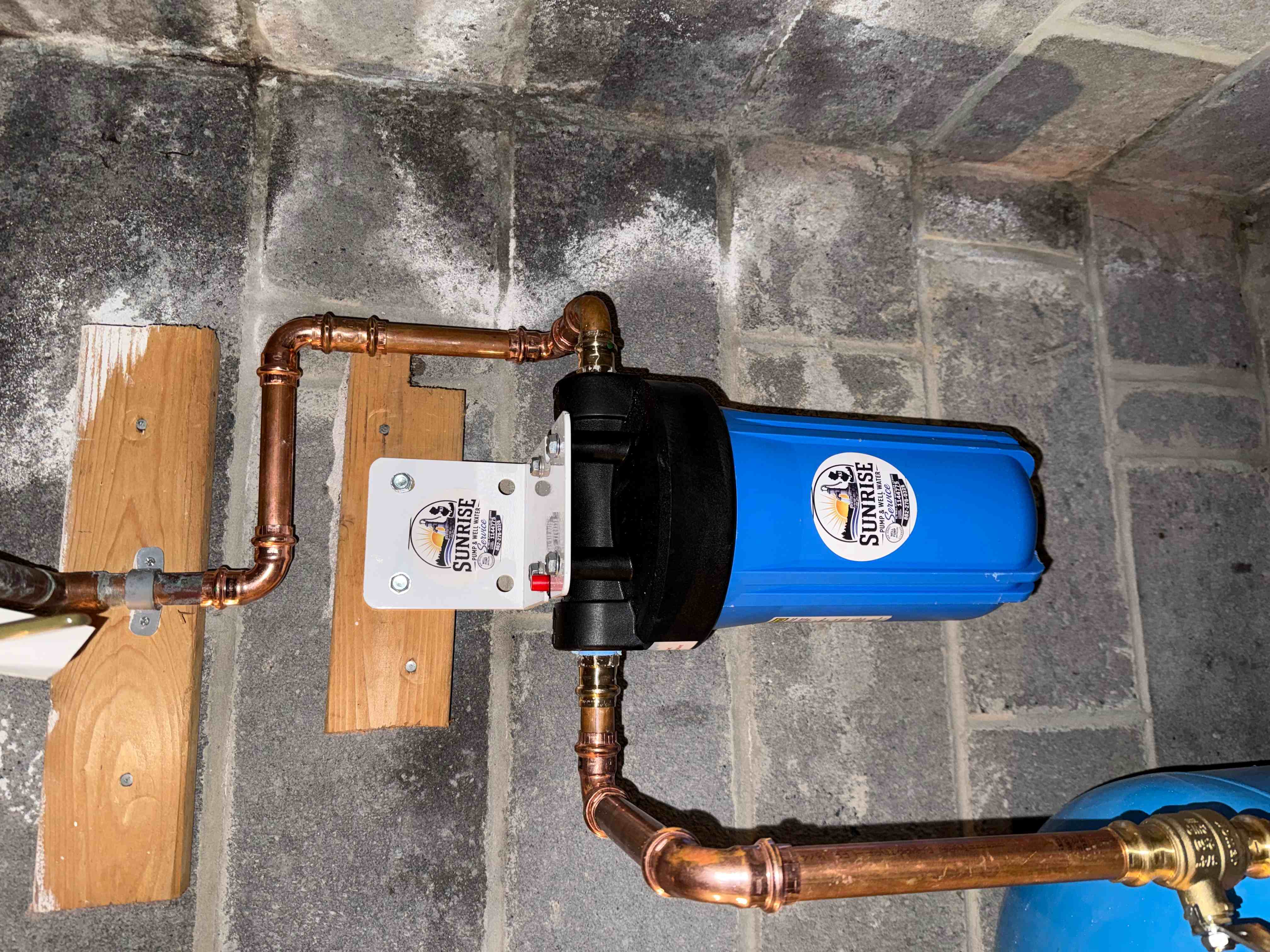
Dissolved iron has to be oxidised into a solid particle before it can be filtered. These systems introduce air or an oxidant and then filter the result out of a media bed, backwashing themselves periodically. A plain cartridge filter under the sink will not remove dissolved iron — there is nothing to catch until it's been oxidised.
Sizing and order of operations
The order of equipment matters as much as the equipment: sediment ahead of everything, iron removal ahead of a softener, softening ahead of a UV lamp. Systems installed in the wrong order foul each other, and that is one of the most common things we find already plumbed in.
What a test has to say before we quote anything
Iron and manganese concentrations, pH, hardness and whether iron bacteria are present all change the answer. Anyone quoting equipment for stained fixtures without a test result is guessing. See our well water testing page.
Drilling a new well and sealing an old one are a different licence — a licensed well driller — and we don't do that work. See our NJ pump installer licence page.
Straight answers
Questions we get on this one
Will a softener remove iron?
A softener will remove a small amount of iron, but iron it wasn't sized for fouls the resin and kills capacity over time. Where iron is the real problem, it belongs ahead of the softener with proper iron filtration, not in the softener.
Why does my water stain only the hot side?
Heating water accelerates the oxidation of dissolved iron, so the staining often shows up first on the hot side — the water heater, the hot taps, the laundry. The iron is in the cold water too; the heat just makes it visible faster.
What is the swampy smell?
A swampy, oily or musty smell with a reddish-brown slime is usually iron bacteria — a living nuisance organism, not a health contaminant. It clogs filters, pressure switches and toilet tanks and needs a different approach to plain dissolved iron.
Do I need to replace my stained fixtures?
Stained fixtures are a symptom, not the problem. Fix the water and the staining stops getting worse. Existing stains can often be cleaned; badly etched fixtures may not come back, but replacing them without fixing the water means you'll stain the new ones too.
Will this fix my laundry?
If iron or manganese is what's turning your laundry orange or grey, removing it from the water stops the staining. Clothes already stained won't reverse, but new loads won't pick up the discolouration.
How often does the media get changed?
It depends on the water and how much the system is handling. Backwashing iron filters regenerate themselves, but the media bed eventually exhausts. We set the change interval to your actual water, not a generic calendar.
We answer around the clock
No water? Call. Don't type.
(862) 276-0328No water right now? Call (862) 276-0328.
Or request service online — but if you're standing in a dark basement with no water, the phone is faster.